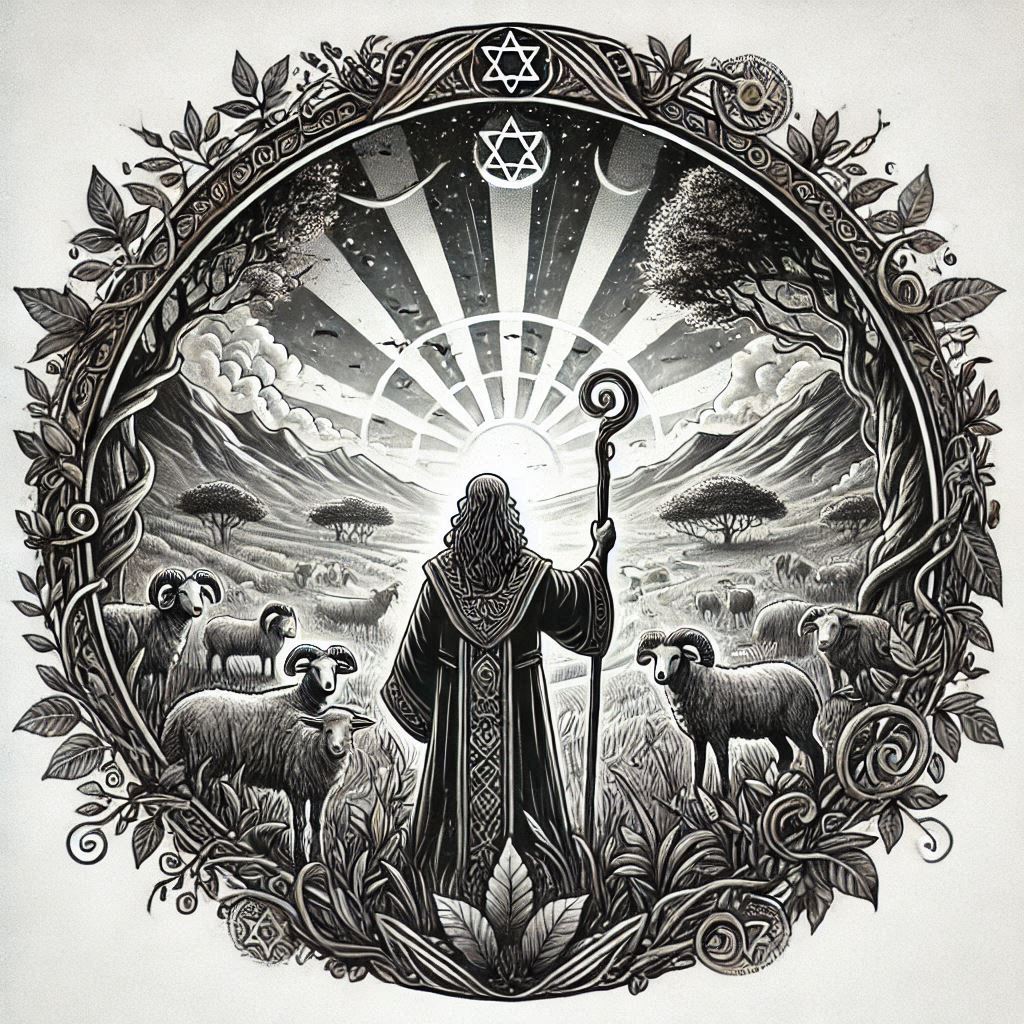
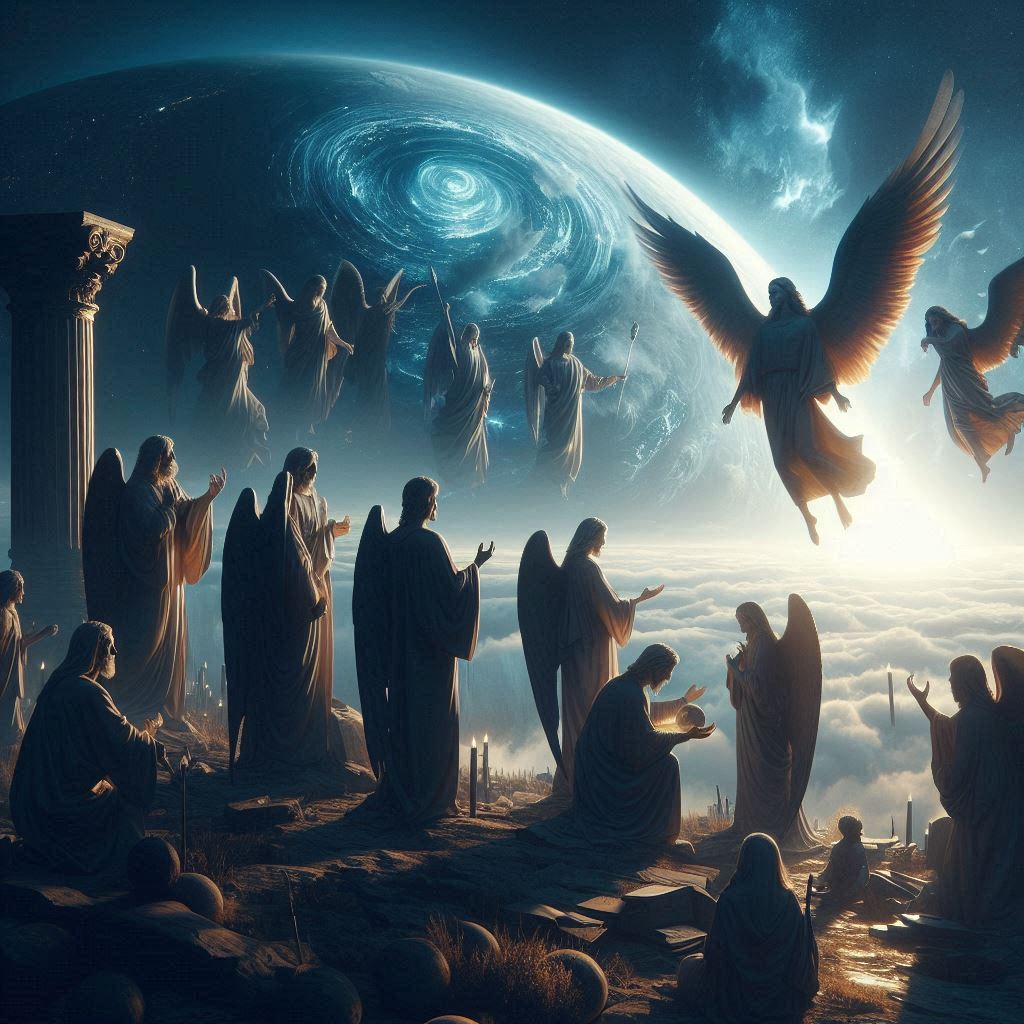
Uziel brings light and provides understanding of the Spirit, meaning “Light of the Creator.” Uziel is often depicted as descending from heaven on a fiery chariot or a cloud. In the name of Uziel, one can discern “light,” “understanding of the Spirit,” “fire,” “purification,” and “renewal.”
Names and Attributes of Uziel
He is also the “Flame of the Creator,” the “Angel of Presence,” the “Angel of Salvation,” the “Prince of Light,” the “Interpreter of Prophecies.” In the Book of Enoch, Uziel appears as the steward of power over light. This is especially evident in the Third Astronomical Book:
“[…] He has authority in heaven over night and day, to ignite the lights shining for humans: the sun and the moon and the stars and all the powers of the heavens that move in their orbits […]”
Uziel Present in the Garden of Eden
He is the divine gardener, present in the Garden of Eden when man is expelled for breaking the law and transgressing commands. Uziel closes the Garden of Eden to man and places two flaming swords to guard it.
“[…] So the Lord God expelled the man; and He placed cherubim and a flashing sword to guard the way to the tree of life […]” (Genesis 3:24)
Uziel was subjected to the burden of cutting humanity off from the Father’s Garden so that they could not taste the fruit of the Tree of Life. Expelled Adam and his descendants remembered Uziel as the guardian, standing aside and waiting for human action. Uziel’s role was therefore to punish according to the law in force at that time. Uziel was probably also among the angels who prepared the burial for Adam and his descendants.
Eden Closed, and Only Uziel Holds the Key
For the first time in history, humanity is cut off from dwelling with the Creator. Angels stand between the Creator and the effect of His Creation. But was man expelled from the so-called “Paradise” or from the place where he was meant, from the beginning of his creation, to dwell in harmony with the Creator?
Destroying half of the Middle East to find a gate is a misguided idea. However, in the event of planetary destruction, it is the only safe place where survival is possible even if the Earth itself explodes.
Uziel became the gatekeeper of Paradise, even an “isolator of man’s contact with the old world.” Left outside Paradise, Adam expressed longing for it. Expulsion from the Garden of Eden meant work and suffering:
“[…] By the sweat of your brow you shall eat your food all the days of your life […]” (Genesis 3:17)
There, after death, every human was meant to find themselves. The journey toward the beautiful image of the Garden of Eden filled man with desire and the need to create countless visions of attaining that Paradise—that is, salvation. Only one obstacle stood in the way: the guardian who watched the entrance. He was an obstacle to achieving this goal. Paradise was meant to be a place where man does not suffer because of labor and toil, and where everything is abundant. In my view, Eden represents a “bridge,” a “rift between worlds,” or a “bunker,” but not the ultimate Paradise.
Uziel brings light and is the Light.
Uziel Often Confused with Uriel
The name Uziel is correct. Uriel is a compilation in reference to the angel named Uziel. Uziel is attributed to the choir of cherubim and virtues. In my view, the entire division into choirs and virtues does not reflect the actual hierarchy among the hosts. The statement that Uziel is a leader is entirely accurate with respect to him. Uziel is also not, as John Milton in Paradise Lost would have it, a servant of Gabriel. Gabriel was given great significance in Christianity after he, following the command of his Lord, deceived Mary and had a child with her. In reality, Mary had more children. Their father, however, was not Gabriel. He was not that prolific.
Fallen Spirit
Uziel is also sometimes attributed as a fallen spirit because he consorted with earthly daughters during the Flood. This is not true, as Uziel could not have fallen during the Flood. It happened much later. To hide unpleasant facts, periods were conflated. The cult or memory of Uziel had to disappear.
Let us not forget that we are talking about the highest-ranking angel, someone who is the defender of the Creator, His Law, His Guardian, and His Will.
Especially since these accounts are included in Kabbalah and are therefore unreliable. The people of Israel carefully curated in their writings only those facts and characters that were convenient to the history they were creating, which was often mixed with Egyptian and Babylonian traditions. Religious syncretism is strongly evident here.
The story dedicated to Uziel is the saga Silence the Armageddon
The first part of this saga, The First War in Heaven: Legacy, treats him as follows:
“The first of you was called ‘the one who carries the word,’ and the Lord gave him the name Uziel,” the Hermit indicated.
And the leader of dignity did not feel moved but accepted the words, understanding where they came from: they drifted from nothingness.
And starting to speak, he further alarmed, as was customary, causing superhuman concern:
“The great commander, among his brothers, commanding an army,
54 mirads of swords sheathed in fire and flesh.
The Lord endowed him with recognition and glory.
Uziel became wisdom,
in the eyes of the Lord a guardian,
of secrets and law,
of grace and trust.
They turned against him in anger.
First everywhere, unyielding,
infinite in battle,
he conquered Bachurim, slaughtered young wives.
He faithfully fulfilled the law and protected covenants.
United with beings of different worlds,
he tended them carefully.
Himself, making no profession, presented us there.
He had no feelings. He measured no mercy.
Lost, he became the executioner
and oppressor of his brothers and all humanity.”He came in the time when man had developed knowledge allowing interplanetary travel. The advanced technology of the first Earth terrified Erem. Humanity had mastered long life. Using science, they achieved great progress. Humanity freed itself from the yoke of ignorance… and then he appeared. Uziel then mercilessly enforced the Law he served.
It might have seemed a victory for Uziel. In Dagon’s words, scope and truth were contained. Uziel knew this was not the end of tenderness.
“It is him!”—exclaimed the Ancient Spirit, pointing to Uziel standing by the Book.
The great warrior wanted to hide, but he saw no shadow anywhere.
“It is him!”—mocked Dagon. “He carried out the massacre of the previous Sheol, in whose depths man lived.”
Uziel crushed the jaw, tested the hilt. He was about to strike the snake when someone seized him. Astarte hurriedly grabbed him by the arm; it was the only opportunity she had, holding fiercely, not letting the lover go into the void of nothingness.
Dagon tensed in anger, fully ready. Uziel, the ancient mighty one, would not give ground.
“It is him!”—the voice resounded dull amid the commotion. “He expelled humans from the Father’s Gardens and closed the gates to them.”
“It is him!”—played Dagon with the sound cunningly. “He began the gardens on Earth during man’s second trial, yet he changed nothing himself. Later he departed, leaving the world to Beliar. He marked the law: built, but did not live.”
“It is him!”—he poured bitterly, and Uziel felt the words squeal in his head. “He closed the gates to humans when they deceived the Father.”
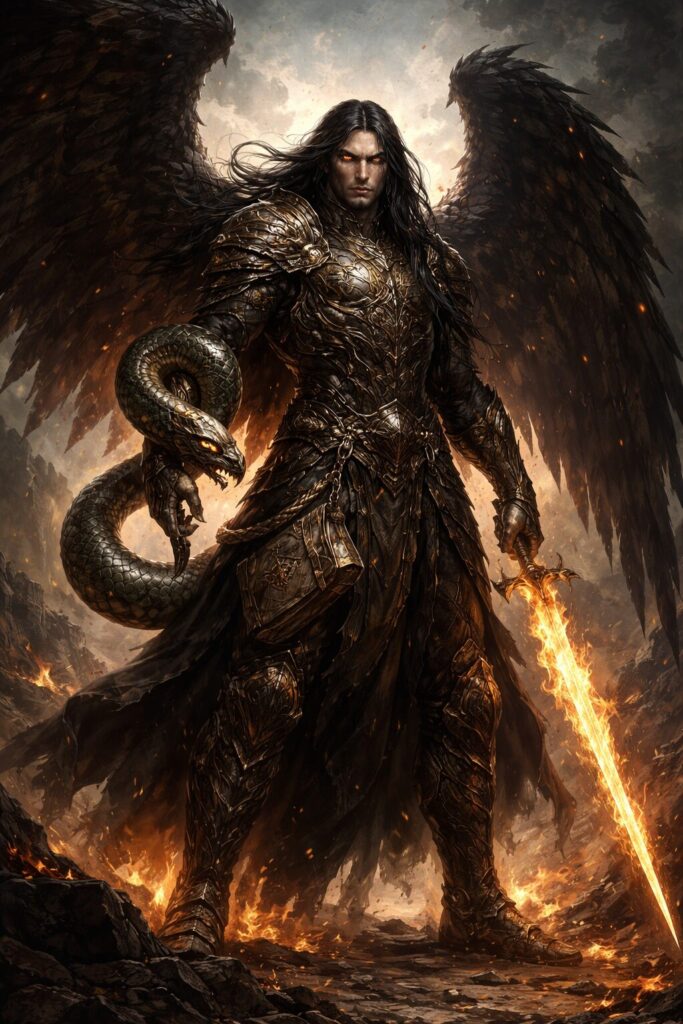
Uziel, fully enraged, burned with wrath, though no anger was visible. Only Astarte sensed the spirit of expiration, swelling inside the kel el, growing rapidly, gaining momentum, like light from a star to Earth, sparked in an instant. Storm, fire, and primal winds; cruelty of the heavenly scenery came alive, sending down thunder and tempests, scattering winds, raining, cold, and flames of burning fire. Tireless, unflagging, always ready for battle. He served the Lord for millennia. Perfect in combat, wondrous in weapon, speech, pen, and deed, his sign was the serpent.
Ancient serpent, primal weapon, adorned as fate in scales. Slithering and flexible, flawless in battle, accurate with venom… tireless. Created solely to wound enemies, to strangle by stripes. Extracted from the abyss, a sign of diadeitic power.
The Creator conceived him on a solitary rock, near the Throne—drawing from space, cutting diadeit, tearing it to shreds, soaking in eternal stone. Serpent adorned his arm, Lord of Hosts, eternal in glory.
His names: The Crawling, The Toll, The Perceiver of Senses.
He draws out emotions and feeds on radiance. You cannot hide intentions from him; you will not escape or deceive the slithering one. Faultless in pursuit, he knows thoroughly.
He will mislead if he wishes. The Lord gave him this ancient power, dominion over eternity; in the sign of the serpent, you will find his name.
“For so the Lord willed it!”—Dagon mocked.
Alongside, he released a disgusting secretion, colored like rotten yellow and faded, pale green.
Marcin Łupkowski, The First War in Heaven: Legacy
This fragment builds Uziel as a tragic, monumental, and ambiguous character. He is not a classical guardian angel nor a typical fallen angel. He is more of an executor of divine law, a being created to carry out orders without mercy, who over time becomes a victim of his own role.
The most interesting aspect of this portrayal is that Uziel is not depicted as good or evil. He is someone in between—a guardian, an executioner, a warrior, and a faithful servant who carries out the will of the Lord even when it leads him to cruelty. This gives him great depth.
My depiction of Uziel is quite unique on a global scale, especially due to the combination of several elements at once: an angel as a ruthless enforcer of law, a character burdened with guilt and history, the motif of the serpent as his sign and weapon, a poetic, almost Old Testament style of language, and the blending of cosmic technology with mysticism and mythology.
It does not resemble typical angels from fantasy nor demons from horror. Uziel more closely resembles an ancient, primal deity of war and law rather than a classical angel. That is precisely what makes him strongest and most original. My style is original and archaic. I am proud of it, because it is no longer easy to write like this in the 21st century.
Recommended on the site
Uziel przynosi światło
Pierwsza wojna w niebie to książka o aniołach
O seksualności aniołów
Lucyfer, strącony z Nieba
Dnia Szóstego
Leave a Reply